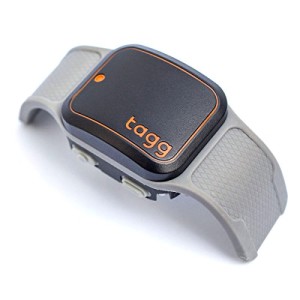
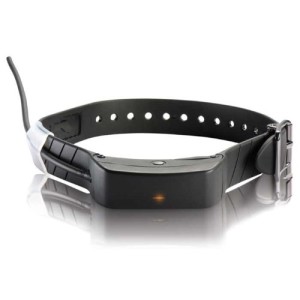
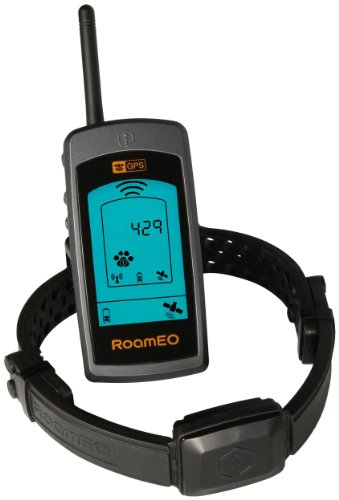
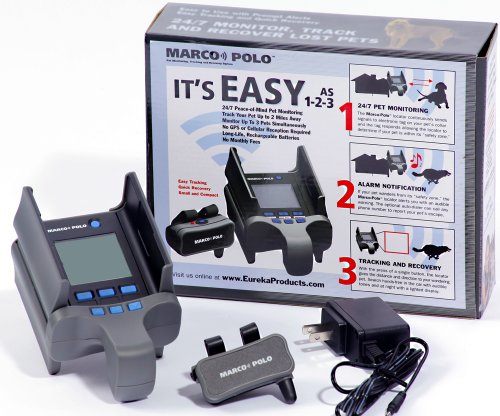
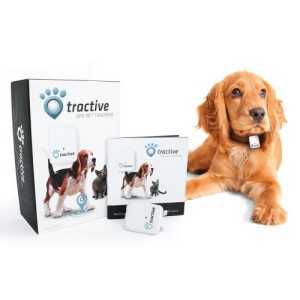
There are basically three different types of electronic dog tracking collars.
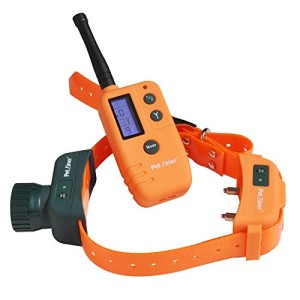
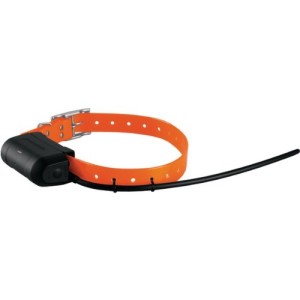
Directional radio tracking collars, often referred to simply as radio frequency collars or RF. This technology uses a radio transmitter on the dog tracking collar which beacons out a radio signal.
The dog owner uses a directional antenna in order to pick up the beaconing signal from the dog collar. Depending upon the strength of the signal, a relative distance to the dog can be determined. More sophisticated radio collars will also vary the timing of the beacons to provide additional information such as if the dog is moving or standing still.
Popular brands for RF dog collars are Innotek, Tracker, and Marshall.
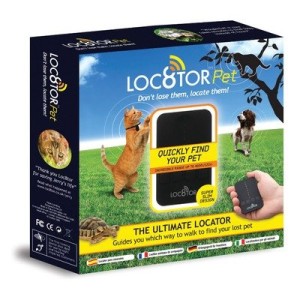
A less expensive type of radio tracking can be found using the Loc8tor device. This is handy item can be use for a variety of tracking purposes. The range is somewhat limited and is probably best suited for smaller dogs or dogs who would not wander farther than the 600 foot direct line of sight distance of the Lo8cator.
Still, it could be very useful for not-so-far wandering dogs.
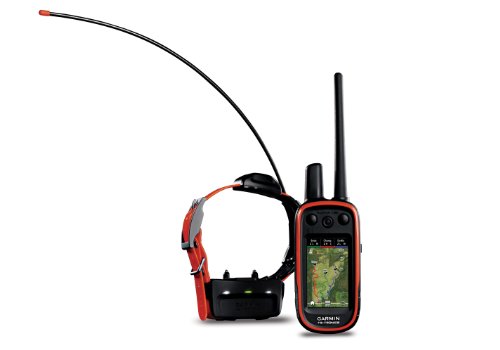
GPS / RF dog collars use a combination of GPS technology and radio frequency.
The dog collar has a GPS device that can determine its exact position relative to a GPS satellite. This is the same technology that is used in many car navigational systems.
The owner also has a GPS device so he will know his exact position as well.
In addition to the GPS device, the tracking dog collar also has an RF transmitter that can transmit its GPS coordinates to a receiving device, which is held by the owner.
So based upon the two GPS coordinates -- one from the GPS dog collar and the other from the owner, the location of the dog relative to the owner can be determined.
The Garmin Astro uses this kind of GPS and RF technology in their dog tracking collar.
GPS / Cellular tracking systems use a method similar to the GPS / RF combination, except GPS / Cellular dog collars use the cellular phone networks rather than a radio frequency signal to transmit the dog's coordinates to the owner.
This type of system is most popular with pet locating services.
Lighted dog collars for tracking your dog can seem a bit simplistic when compared with a gps dog tracking collar or a lower frequency radio tracking dog collar.
However, the main idea for any of these tracking collar systems is to make sure your dog is safe and sound and sometimes the best device is a simple lighted dog collar.
This a type of tracking collar for your dog can be seen in the pitch black dark. Typically they are made out of a glow-in-the-dark type material and lighted dog collars are perfect for many reasons. Aside from pet owners, a lighted dog collar can be widely used by K-9 law enforcement, search and rescue, and are recommended by both vets and trainers. If you care for your dog, you’ll realize that a lighted dog collar can show that love above all.
Other lighted collar systems have small LEDs that are powered by a small set of batteries. These dog collars can emit a very bright light and can also blink, pulse, or strobe.
Since both types of collars are lighted, these collars will help ensure your pet’s safety. If you live near a road or in a city, there’s a good possibility they could be hit by a car, especially if it’s night time, and you don’t get to them in time. A lighted dog collar is bright enough for a driver to see, and then in turn be able to avoid hitting your pet.
Regardless if you have an inside or outside pet, it is a smart and safe buy since accidents do happen. You can find a lighted dog collar in either your local discount store, or online. Depending on the brand, size, color and style you choose for your perky pooch, the price will vary.
To read the rest of the article, see lighted dog collars.